


Published: April 2026 · Written by Somineni Sharath Chandra
At myPaisaa, we believe in transparency. We do not sell EMI products, so we have no reason to hide the math. This guide uses 2026 RBI regulations to give you the objective truth.
No Cost EMI is a financing model where the interest is masked as an upfront discount or built into the product price. While marketed as interest-free, the buyer is legally liable for 18% GST on the hidden interest component and potential processing fees. In 2026, the RBI mandates that no loan can genuinely be at 0% interest.
Now, let us make that real with a quick story.
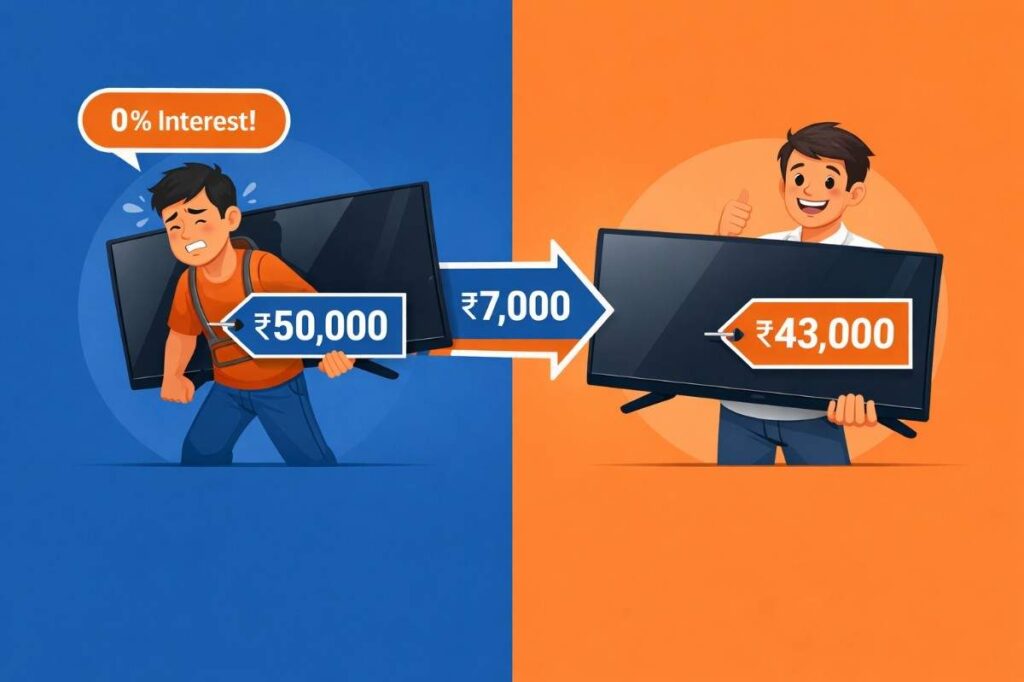
Ravi bought a television worth Rs 50,000 during a sale. The store was offering no cost EMI for 6 months. Ravi thought he was being smart. Zero interest, easy payments, no stress.
What he did not know was that the Rs 7,000 discount he saw on the product page quietly disappeared the moment he selected the EMI option. That Rs 7,000 went straight to the bank as interest. Ravi paid Rs 50,000. The person next to him who paid upfront paid Rs 43,000.
Same product. Same store. Very different price.
This is what we want to help you understand today, so you never end up in Ravi’s situation.
No Cost EMI is also called zero cost EMI or interest-free EMI. It is a payment option where a retailer and a bank work together to let you pay for a product in equal monthly instalments without any visible interest charge.
The keyword there is visible.
Here is something most buyers do not know. The Reserve Bank of India said clearly in its 2013 circular that zero percent interest loans are not a valid concept. Banks simply cannot lend money at zero interest. The cost of money always exists. What no cost EMI does is hide that cost in a way most people never notice.
Think of it this way. Imagine a shopkeeper who normally gives you a Rs 500 discount. But today, instead of giving you that discount, the shopkeeper uses it to pay the bank’s interest on your behalf. You never see the discount. You pay the full price in instalments. The bank gets its interest. Everyone is happy except you, because you do not realise what just happened.
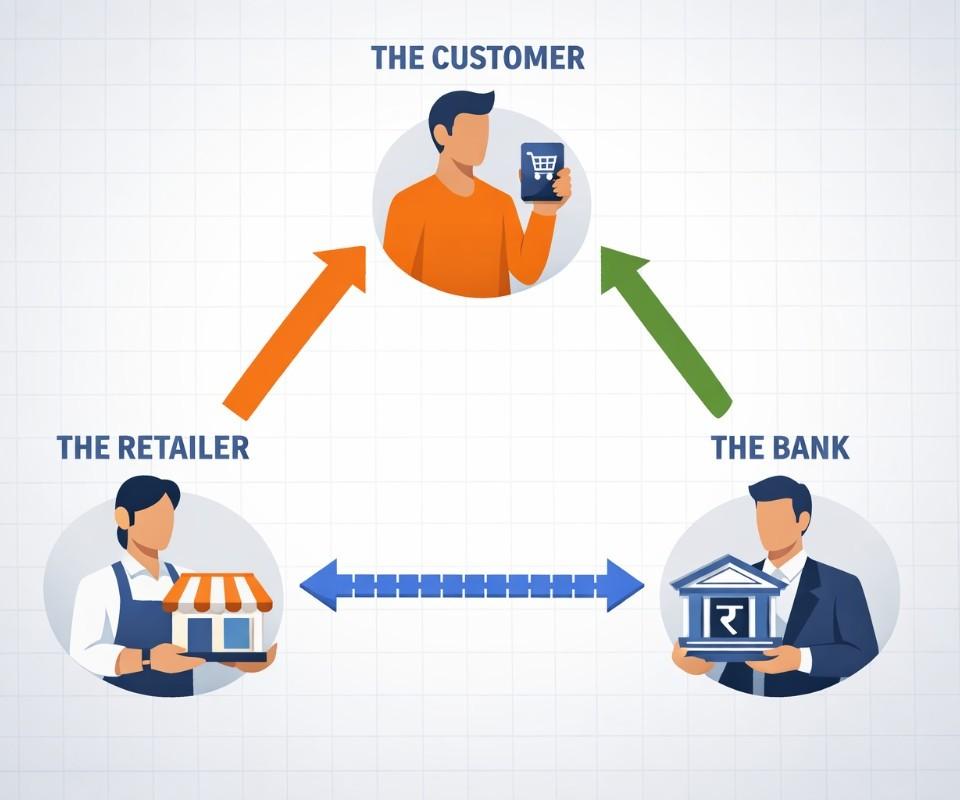
This arrangement involves three parties working together: you, the retailer, and the bank. The retailer absorbs the interest by sacrificing a discount. The bank earns its standard yield. And you pay the full sticker price in instalments, thinking you paid nothing extra.
There are two common ways retailers set up no cost EMI. Both end with you paying more than the person who paid upfront.
This is the most common structure. A product is priced at Rs 30,000. The retailer is ready to give you a Rs 4,500 discount if you pay upfront. So the real price for a cash buyer is Rs 25,500.
The moment you choose no cost EMI, that Rs 4,500 discount disappears. Here is exactly what happens behind the scenes. The bank calculates the interest it needs to earn. The retailer sends that exact amount to the bank as a subvention payment. Your invoice is generated at Rs 25,500 but you never see that discounted price. The bank lends you Rs 25,500 at 15 percent annual interest. Over 6 months you pay Rs 5,000 per month. Total paid: Rs 30,000.
You paid Rs 4,500 more than the upfront buyer. That Rs 4,500 was your interest. You just never saw it labelled that way.
In some cases, the retailer adds the interest amount to the product price before showing it to you. A product that costs Rs 15,000 appears as Rs 17,250 on the no cost EMI page. The extra Rs 2,250 is the interest, already baked into the price. You never knew a lower price existed.
| Pay Upfront | No Cost EMI Method 1 | No Cost EMI Method 2 | |
|---|---|---|---|
| Product price | Rs 30,000 | Rs 30,000 | Rs 30,000 |
| Discount available | Rs 4,500 | Rs 4,500 withdrawn | Not shown at all |
| What you actually pay | Rs 25,500 | Rs 30,000 | Rs 32,250 |
| Extra paid vs upfront | Nothing | Rs 4,500 | Rs 6,750 |
| Effective interest rate | 0% | Around 15% per year | Around 18% per year |
The product and the store are the same. Only the payment method is different. And that difference costs thousands of rupees.
This is the part that surprises most people. And honestly, even most finance articles skip over it completely. None of the top-ranking articles on this topic cover it clearly in text form. So read this section carefully.
When you use a credit card for no cost EMI, the bank is providing you a financial service. Under Indian law, that financial service is taxable. An 18 percent GST is charged on the interest component of your no cost EMI loan.
The retailer’s discount only covers the base interest amount. The GST on that interest is not covered. It lands on you. You will see it on your credit card statement as a processing fee or an EMI conversion charge. Small enough to overlook. Big enough to matter.
The GST Reality: On a Rs 30,000 phone with Rs 4,500 hidden interest, the 18% GST adds Rs 810 to your total cost. Add a processing fee of Rs 99 to Rs 500 and the GST on that fee, and your Rs 30,000 no cost EMI product costs a minimum of Rs 30,810. The no cost promise breaks the moment you read your full statement.
Here is the full breakdown:
| What you are paying | Amount |
|---|---|
| Product price | Rs 30,000 |
| Interest hidden in subvention | Rs 4,500 |
| GST on interest at 18% | Rs 810 |
| Processing fee | Rs 99 to Rs 500 |
| GST on processing fee | Rs 18 to Rs 90 |
| Minimum total paid | Rs 30,810 and above |
One more thing worth knowing. Traditional personal loan interest is exempt from GST. Credit card EMI interest is not. That is a distinction the checkout screen will never highlight for you.
Most no cost EMI articles stop at the GST section. This one does not, because what we are about to tell you is something almost nobody mentions.
The 2026 Foreclosure Reality: The RBI banned foreclosure fees on floating-rate loans from January 2026. But most credit card no cost EMIs use fixed interest rates, so this protection does not apply to them. If you close a Rs 60,000 EMI in Month 3 to free up your credit limit, expect a penalty of 2 to 5 percent on the remaining Rs 45,000 outstanding balance. That is Rs 900 to Rs 2,250 extra, charged simply for paying off your own debt ahead of schedule.
New 2026 RBI rules do require that any permitted foreclosure charges must be clearly listed in your Key Facts Statement before you sign. The rule is simple: always read the Key Facts Statement before confirming any EMI. If the foreclosure charge is not clearly written there, ask the lender directly before you proceed.
Beyond the hidden interest and GST, two more costs catch people off guard.
Your credit limit gets blocked immediately
When you use a credit card for no cost EMI, the full product value is blocked against your credit limit from day one. Not just the monthly instalment. The full amount.
Say your credit limit is Rs 1,00,000 and you buy a Rs 60,000 television on a 12-month no cost EMI plan. Rs 60,000 gets blocked immediately. Your usable credit drops to Rs 40,000 for the next full year.
Most people assume only Rs 5,000 per month gets blocked. That assumption is expensive.
Your credit score can take a hit faster than you think
No cost EMI is a loan. It appears on your CIBIL report just like any other loan. But here is what changed in 2026 that makes this more serious than before.
From July 2026, the RBI requires all banks and NBFCs to update your credit data with bureaus every single week. Under the old system, a missed payment took 30 to 45 days to show up. Today, a missed EMI payment is visible to every lender within 7 days.
That means if you miss your EMI on the 5th of the month, any bank you apply to for a loan or credit card on the 12th will already see that missed payment on your report. One missed payment. One week. Permanent record.
Even if you pay perfectly on time, having Rs 60,000 blocked as credit utilisation from day one raises your utilisation ratio, which credit bureaus treat as a risk signal. Your score can drop even when you are doing everything right.
Want to understand exactly how your CIBIL score is calculated and what hurts it? Our Credit Score Guide covers it in plain language.
Let us answer this directly and show you all three options side by side, including the one no checkout page will ever offer you.
| Feature | Pay Upfront | No Cost EMI | Save First |
|---|---|---|---|
| Final price | Rs 25,500 with discount | Rs 30,810 with GST and fees | Rs 25,500 with discount |
| Interest paid | Rs 0 | Hidden in price | Rs 0 |
| Credit score impact | No impact | Weekly reporting risk from 2026 | No debt, no risk |
| Discount received | Yes | Forfeited | Yes |
| Processing fee | None | Rs 99 to Rs 500 plus GST | None |
| Credit limit blocked | No | Full amount from day one | Not applicable |
| Foreclosure risk | None | 2 to 5% on fixed-rate EMIs | None |
| Financial pressure | One payment and done | Monthly commitment for months | Gradual, no obligation |
The honest conclusion is this. Paying upfront and saving first both cost less than no cost EMI in almost every real scenario. The only exception is when no upfront discount exists and the seller genuinely absorbs the full interest, which is rare.
This is important to understand, because no cost EMI is not just a pricing trick. It is a psychological one too.
When you pay cash, you feel the money leaving. Researchers call this the pain of paying. It is a natural brake on impulse buying. Physical cash makes it strongest. Digital payments reduce it. A one-click EMI approval almost removes it entirely.
When a Rs 80,000 television is broken into Rs 6,666 per month, something interesting happens in your brain. The purchase moves from your mental bucket of big scary expenses into your monthly routine budget. The guilt disappears. The hesitation goes away. The purchase feels reasonable. This is called mental accounting and it is very well studied in behavioural economics.
You are not weak for feeling this. Everyone does. But knowing it exists helps you pause for a moment before clicking confirm.
From 2026, the RBI has also banned several design tricks that retailers and banks used to make EMI feel even more automatic. Pre-checked opt-in boxes, countdown timers creating fake urgency, and buried opt-out buttons are now illegal. These were called dark patterns and they were specifically designed to push you into EMIs before you had time to think.
The RBI introduced its strongest consumer credit protections yet through the Responsible Business Conduct directions and the Pre-payment Charges on Loans directions. Here is what these rules actually mean for you.
Separate consent required for every product. Banks can no longer bundle insurance or warranties into your EMI checkout without asking you specifically. If you were previously auto-enrolled into add-ons during checkout, that practice is now illegal.
Dark patterns are banned. Pre-checked EMI boxes, fake urgency timers, and confusing opt-out flows are prohibited. Banks must audit their own checkout interfaces to prove they comply.
No foreclosure fees on floating-rate loans from January 2026. If your loan has a floating interest rate, no lender can charge you for paying it off early. Fixed-rate products like most credit card EMIs may still carry fees, but these must be clearly shown in your Key Facts Statement before you agree to anything.
Weekly credit reporting from July 2026. This is the biggest practical change for borrowers. One missed payment shows up on your bureau report within 7 days. Good payment habits now build your score faster, but one slip is visible almost immediately to every lender in the country.
Standardised late fee caps. Late fees are now capped by law.
| Outstanding balance | Maximum late fee per cycle | Grace period |
|---|---|---|
| Up to Rs 5,000 | Rs 100 to Rs 300 | Minimum 3 days |
| Rs 5,001 to Rs 10,000 | Rs 300 to Rs 500 | Minimum 3 days |
| Rs 10,001 to Rs 25,000 | Rs 500 to Rs 700 | Minimum 3 days |
| Above Rs 25,000 | Rs 700 to Rs 1,000 | Minimum 3 days |
We are not here to tell you no cost EMI is always bad. Sometimes it genuinely helps. Here is an honest guide.
It makes sense when:
You have a real cash flow problem and the product is essential. A refrigerator that stopped working, a laptop you need for work, a medical device. These are legitimate situations where EMI solves a real problem.
No upfront discount exists for that product anywhere. If the price is the same whether you pay upfront or on EMI, you are not sacrificing anything extra.
You want to build your credit history. A short, clean EMI that you repay on time every month is a practical way to start building your CIBIL score, especially if you are new to credit.
You have done the full calculation including the processing fee, the GST on interest, and any discount you are giving up, and the total still works for your budget.
It does not make sense when:
An upfront discount is available. You will always pay more by choosing EMI in this case.
You already have two or more active EMIs. Adding another strains both your monthly budget and your credit score at the same time. You can save the amount in 3 to 6 months. Waiting costs you nothing and saves you every hidden charge.
The product is a want and not a need. Spreading an impulse purchase over 12 months makes it feel affordable. That feeling is exactly the trap it is designed to create.
The tenure is longer than 6 months. The longer the loan runs, the more likely something unexpected happens in your life, and from July 2026, even one missed payment shows up on your bureau report within 7 days.
Most people think there are only two options. Pay the full amount upfront or break it into EMIs. There is actually a third option that very few people consider.
Call it the Reverse EMI.
Here is how the two approaches compare side by side.
The No Cost EMI way: You pay Rs 5,000 per month to the bank. The bank earns interest on your money. You lose your upfront discount. You pay GST on hidden interest. Your credit limit is blocked for the entire tenure. You own the product while still in debt.
The Reverse EMI way: You save Rs 5,000 per month for 6 months. You build Rs 30,000. You walk into the store with a lump sum, ask for the cash discount, and pay Rs 25,500 or less. You own the product outright. No debt. No credit limit blocked. No GST on interest. No processing fee.
The only difference is sequence. In one, the bank takes a cut of your purchase. In the other, nobody does.
There is also a practical benefit beyond just the money. Because the Reverse EMI is savings and not a loan, it does not appear on your CIBIL report and does not block your credit limit. That keeps your credit breathing room clean for when you actually need it, like a home loan application or a genuine emergency.
For people who find it hard to stay consistent with saving, a structured savings system helps. myPaisaa is a digital chit fund where you commit to a fixed monthly amount and access a lump sum when your goal arrives. It is not a loan, so it does not affect your credit score or block your credit limit. You save on your own terms and buy when you are ready, at the best possible price.
Explore myPaisaa chit plans and find one that fits your monthly budget
If you are new to chit funds and want to understand how they work before taking any step, these are a good place to start:
What is no cost EMI and how does it work?
No cost EMI lets you pay for a product in monthly instalments without a visible interest charge. But the interest does not go away. It is either taken from a discount you would have received or added to the product price before you see it. The RBI confirmed in 2013 that zero percent interest loans are not valid. The interest always exists in a no cost EMI transaction. It is just restructured so most buyers never notice it.
Is no cost EMI better than paying upfront?
Generally no. If an upfront discount is available on the product, choosing no cost EMI means you forfeit that discount, which effectively becomes your interest payment. Add the 18% GST on the bank’s interest component and any processing fees, and the upfront buyer consistently pays less. The only exception is when the seller offers the same price for both options and genuinely absorbs the full interest cost.
What are the disadvantages of no cost EMI?
The main ones are: you usually lose an upfront discount so you pay more than the cash buyer; 18% GST is charged on the bank’s interest and shows up as a processing fee; your full credit limit is blocked for the entire loan tenure from day one; from July 2026 a missed payment shows up on your bureau report within 7 days; and closing the loan early may attract foreclosure charges of 2 to 5% on fixed-rate products.
Does no cost EMI affect your credit score?
Yes. It is recorded as a loan on your CIBIL report. On-time payments can slowly improve your score. But the full product value is blocked as credit utilisation immediately, which is a risk signal to bureaus even when your payments are perfect. From July 2026, the RBI requires weekly bureau updates. One missed EMI payment is visible to every lender in the country within 7 days, not 30.
Is no cost EMI a good option?
It depends entirely on your situation. It works well when you have a genuine cash flow need, the product is essential, no upfront discount exists, and you have checked the full cost including fees and GST. It is a poor choice when a discount is available, when you can save the amount in a few months, or when you are already managing other EMIs. Always calculate the total outflow including all fees, not just the monthly instalment number, before deciding.
Join 10,000+ Subscribers
Be a part of our growing community


Comments (No Responses )
No comments yet.